
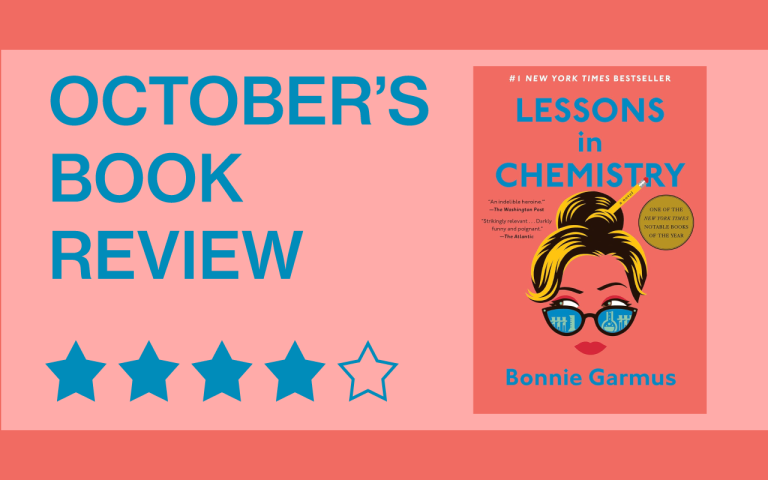
October’s bookclub meeting was the second one we held in Canggu, so it was lovely to see even more new people join! The latest book was Lessons in Chemistry by Bonnie Garmus, a witty and inspiring novel about Elizabeth Zott, a brilliant chemist in the 1960s who defies societal norms to pursue science and accidentally becomes a TV cooking star who teaches women to think for themselves.
This book is very multifaceted because it essentially tells Elizabeth’s life story. There’s a love story, a story about family, a story about loss, and a story about injustice. It’s definitely a frustrating read at times due to the blatant misogyny Elizabeth faces, especially in her professional life. Elizabeth is a chemist—that’s her identity, and she’s not willing to compromise on it. Even as a cooking star, she makes it very clear to her viewers that she is first and foremost a chemist. Instead of setting aside chemistry to cook, she uses chemistry to explain and demonstrate how to approach cooking from a scientific perspective. She takes cooking very seriously and doesn’t want to patronize the women watching—something the TV station struggles to accept.
Elizabeth’s relationships felt very genuine—whether romantic, familial, or platonic—they were grounded and well-written. Even though we don’t always hear Elizabeth’s direct thoughts, the book does a great job of portraying her emotional depth through her actions. Elizabeth clearly shows autistic tendencies, which both help and hinder her as she often struggles with isolation from her female peers. Although she isn’t officially diagnosed, the book effectively illustrates how difficult it can be for many neurodivergent women to navigate life while facing oppression and a lack of solidarity.
Some aspects of the plot feel a little one-dimensional. There’s a strong focus on career-oriented empowerment, as Elizabeth is deeply passionate about her identity as a chemist, but the story slightly lacks a more inclusive perspective on women’s rights. Even though Elizabeth respects housewives, there’s an underlying attitude that every housewife is waiting for something better or secretly wants to do something else. It would have been interesting to see the “housewife” identity explored as something more than a default or placeholder role for the average woman.
There were also moments when I had issues with the tone of the book. Her dog, Six-Thirty, has a major impact on the plot, but I wasn’t a fan of how “human” he sometimes felt—particularly in the chapters told from his perspective. I didn’t mind his role in the story; it was just the execution that I think could have been handled differently.
Overall, I don’t have any major criticisms of this book. I thoroughly enjoyed reading it and even cried at times. It was a satisfying journey from start to finish, and the story felt well-planned and thoughtfully written. I’d give this book 4 out of 5 stars!
By: Elvira Svensson